Selmar Cerini
סלמר צריני
1860–1923
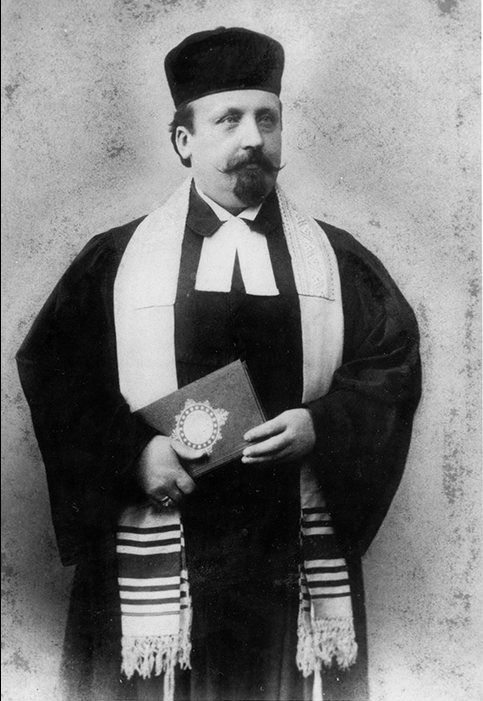
Selmar Cerini (1860-1923) was a cantor and dramatic tenor from Wólka near Warsaw who sang leading opera roles on German stages before becoming chief cantor of the New Synagogue in Breslau, where he served from the mid-1890s until his death. He was among the first cantors to record, and left more than 120 recordings.
Also known as Salomo Steifmann, Salomo Steifman, Oberkantor Selmar Cerini, סלמר צריני, שלמה יצחק הכהן שטייפמן
Born 15 December 1860, Wólka, near Warsaw, Poland
Died 11 May 1923, Breslau (now Wrocław, Poland)
Life and career
He was born Salomo Steifmann on 15 December 1860 in Wólka, near Warsaw, into an Orthodox Jewish family. As a boy he left home to sing in synagogue choirs, and from about twelve he was a soloist at the synagogue in Płońsk for two years. To win over the wealthy parents of his fiancée he went into their business, but the pogroms of 1882 ruined them, and he turned to the cantorate, first in Zagórów and then in Łódź.
In the mid-1880s he moved to Breslau in Germany, where he was urged to train his voice and went to Berlin to study. At first he had no papers and had to hide from the police, until patrons helped him obtain a residence permit. His first appearance was as the offstage Muezzin in Lecoq's opera Ali Baba, under the name Selmar Cerini, which kept his identity hidden. The success brought concert work and stage engagements in Halberstadt and Stettin.
Offered a five-year contract in Leipzig, he left without singing there because of the antisemitism in that city, and became first tenor in Breslau instead, in roles such as Eléazar, Raoul, Radamès and Manrico, with guest nights at the Kroll Opera in Berlin and a spell in Strasbourg. In the mid-1890s the New Synagogue of Breslau made him its chief cantor, and he held the post until he died in 1923. In 2016 an installation by the artist Kitty Hubbard on the synagogue's surviving wall was dedicated to him.
Known for
- Chief cantor (Oberkantor), New Synagogue, Breslau
- First tenor, Breslau opera
- Muezzin in Lecoq's Ali Baba
- Kol Nidre (Gramophone Concert 263) (1908)
- Kozak (Moniuszko)
On record
The archive has 7 historic 78 rpm records with Selmar Cerini, from 1908: hear them. They play from the Internet Archive.
His cantorial records here are Kol Nidre, in a 1908 Gramophone issue with the choir of the New Synagogue and harmonium and in a second copy, together with V'hogen Baadenu, Jaaleh and Kaddisch, credited to him as Oberkantor or Chief Cantor. Most of the labels are not legible.
Related performers
Sources
- סלמר צריני (Hebrew Wikipedia)
- Selmar Cerini (Historical Tenors)
- Selmar Cerini, the Polish/Jewish Jan Kiepura from Breslau (Porta Polonica)
- Selmar Cerini, Kol Nidre (Gramophone Concert 263) 1908 (YouTube)
- Cerini, Selmar, Cantor, Kol Nidre (Gramophone Concert 263) 1908 (Internet Archive)
- Selmar Cerini (Wikidata)
- Selmar Cerini (MusicBrainz)
Biography updated November 2026.
On 78 rpm records (7)
Historic records, played from the Internet Archive. All the 78 rpm records
- Kol Nidre1908 · 78 rpm · 4:50 · Internet Archive
- JaalehNone legible · 78 rpm · 3:19 · Internet Archive
- KaddischNone legible · 78 rpm · 3:19 · Internet Archive
- Kol NidreNone legible · 78 rpm · 3:23 · Internet Archive
- Kol Nidre, Part 1Polydor · 78 rpm · 2:44 · Internet Archive
- Kol Nidre, Part 2Polydor · 78 rpm · 1:59 · Internet Archive
- V'hogen BaadenuNone legible · 78 rpm · 3:20 · Internet Archive